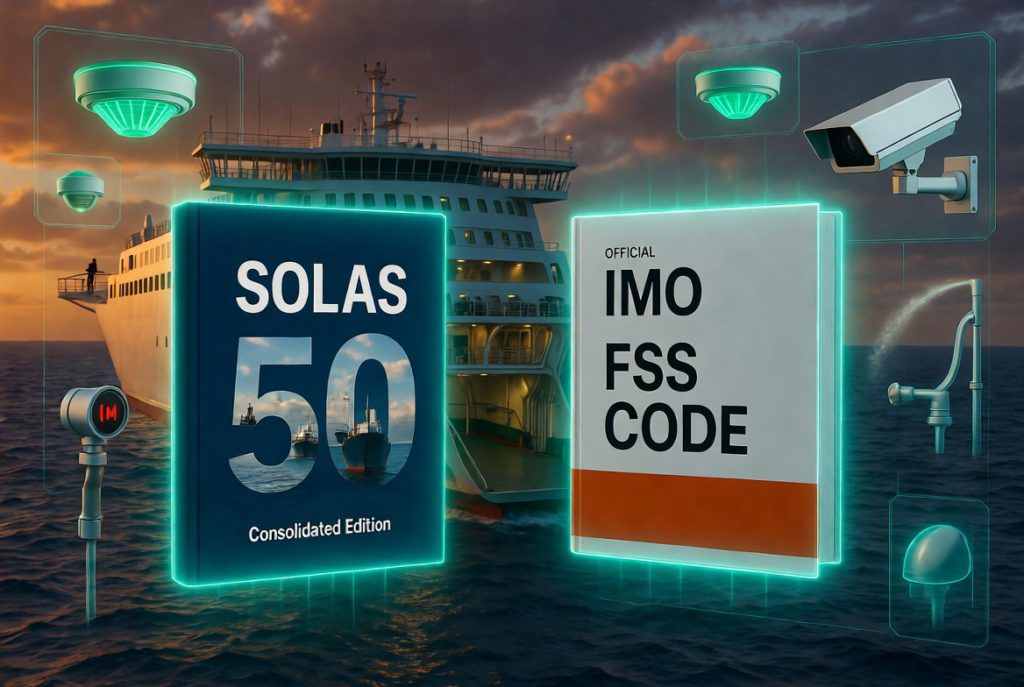
Three months ago, on 1 January 2026, the biggest shake-up in ro-ro fire safety in over a decade quietly entered force.
Backed by the landmark EMSA FIRESAFE studies, IMO Resolutions MSC.550(108) and MSC.555(108) have rewritten SOLAS Chapter II-2 Regulation 20 and key chapters of the FSS Code. The result? Stricter, smarter fire detection, monitoring and suppression rules specifically designed to stop vehicle-deck fires before they spiral out of control.
For every ship’s officer walking a ro-ro or vehicle carrier, every cadet dreaming of their first bridge watch, and every shore manager signing off safety management systems, this is not another paper exercise. This is the new reality of fire patrol on the world’s busiest vehicle decks.
What Actually Changed – And Why It Matters
The amendments target the exact fire hazards the EMSA FIRESAFE project identified: rapid fire spread on open and closed ro-ro spaces, weather decks used for vehicles, and special category spaces.
For new ships (keel laid on or after 1 Jan 2026):
- Individually addressable smoke AND heat detectors throughout vehicle, special category and ro-ro spaces (linear heat detectors now explicitly accepted when tested under normal ventilation).
- Continuous video monitoring (CCTV) with immediate playback capability – cameras positioned high enough to see over cargo and vehicles 24/7.
- Upgraded fixed water-based fire-extinguishing systems (including weather-deck coverage) with improved performance standards under the revised FSS Code Chapters 7 and 9.
- Tighter structural fire protection, revised opening arrangements and mandatory safe-distance requirements from normally occupied service spaces.
For existing ro-ro passenger ships:
- Full compliance required no later than the first survey on or after 1 January 2028 – including retrofitting water monitors on weather decks and enhanced detection/monitoring.
These are not optional upgrades. Non-compliance now equals port-state control detentions and potential charter-party headaches.
The Real-World Impact on Bridge Teams & Shore Operations
Senior officers on ro-ro and vehicle carriers are already feeling the difference: more precise fire alarms that pinpoint the exact location instead of vague “somewhere on deck 3” alerts. Chief engineers are rewriting fire drills around the new video-monitoring protocols. Deck officers now have legal obligations to maintain clear lines of sight for CCTV and ensure detectors are never obstructed by cargo.
Shore-side technical and safety managers are busy updating SMS manuals, revising fire-control plans and negotiating retrofit schedules with classification societies. Insurance surveys are getting tougher. Charterers are already writing “SOLAS II-2/20 2026 compliant” clauses into contracts.
For new entrants to the merchant navy? These rules are your new normal. The cadets who master them early will be the ones fast-tracked onto premium ro-ro tonnage.
How These Changes Are Reshaping Maritime Training
The EMSA FIRESAFE-driven amendments have just rendered yesterday’s fire-safety training partially obsolete – and Glasgow Maritime is already adapting.
Training providers must now deliver:
- New STCW-compliant modules on individually addressable detection systems, linear heat detector theory and calibration.
- Advanced CCTV and video-monitoring operations – including real-time assessment, immediate playback drills and integration with the ship’s fire alarm system.
- Enhanced fixed water-mist and water-spraying system training – performance standards, maintenance and activation under realistic ro-ro deck conditions.
- Updated fire-drill scenarios incorporating weather-deck fire risks and revised structural protection requirements.
- Accelerated retrofit awareness courses for serving officers so they can return to their vessels fully compliant and confident.
- Cadet pathway integration – embedding these competencies from the earliest stages rather than bolting them on later.
Centres that move fast will produce officers who are not just legally qualified but operationally ahead of the curve. Those that hesitate will send graduates onto ships where the new rules are already in force – and the learning curve will be steep, expensive and potentially career-limiting.
The ships haven’t changed overnight. But the fire-safety standard just jumped a generation.
This is the EMSA FIRESAFE legacy in action: fewer fires, faster detection, smarter response – and safer seas for everyone who works them.