The maritime industry has been hearing one phrase repeatedly over the last few years:
“S-100 is coming.”
But what does that actually mean for ships, bridge teams, training providers and fleet operators?
The answer is simple.
S-100 isn’t just another electronic chart update. It represents the biggest evolution in digital navigation since the introduction of ECDIS.
What is S-57?
For decades, Electronic Navigational Charts (ENCs) have been produced using the IHO S-57 standard.
S-57 was designed for one primary purpose:
Creating digital nautical charts.
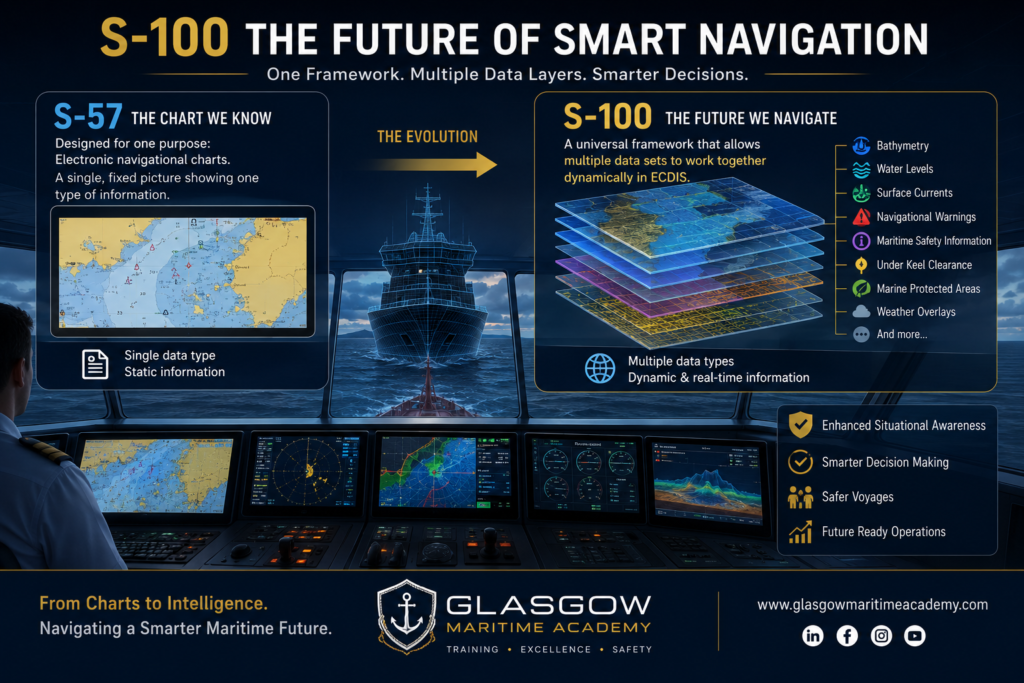
These charts are accurate, reliable and scalable, allowing navigators to zoom in without losing detail. However, they remain a single layer of navigational information.
While this system has served the industry well, modern shipping now requires far more than just chart data.
Enter S-100
The IHO S-100 Universal Hydrographic Data Model is a completely new framework for marine data.
Instead of displaying only navigational charts, S-100 allows multiple data products to be integrated into one intelligent environment.
Future ECDIS systems will be capable of displaying information such as:
- Dynamic bathymetry
- Water level predictions
- High-resolution surface currents
- Maritime safety information
- Navigational warnings
- Under-keel clearance information
- Marine protected areas
- Weather overlays
- Future autonomous vessel data layers
Rather than each dataset operating independently, S-100 enables them to work together intelligently inside the bridge navigation system.
The result is a far richer situational awareness for navigators.
Why Does This Matter?
Shipping is becoming increasingly data-driven.
Modern bridge teams must process far more information than ever before.
S-100 enables ECDIS to move beyond being an electronic chart display into becoming an integrated decision-support platform.
Imagine approaching a port where your ECDIS can automatically combine:
- Electronic charts
- Tide predictions
- Water levels
- Dynamic under-keel clearance
- Surface currents
- Temporary navigation warnings
All within a single display.
This is the future S-100 is designed to support.
What Should Fleet Managers Be Doing Now?
Although S-57 and S-100 will coexist during the transition period, shipping companies should already be preparing.
1. Check Software Compatibility
Not all existing ECDIS systems will support S-100 products.
Fleet operators should engage with manufacturers to understand:
- Upgrade paths
- Hardware requirements
- Software licensing
- Future support timelines
2. Invest in Crew Training
Technology alone does not improve safety.
Bridge teams must understand:
- New data layers
- Display settings
- Safety contour management
- Data prioritisation
- Human factors associated with increased information
Without proper familiarisation, additional information can become distraction instead of assistance.
3. Prepare Operational Procedures
The arrival of S-100 may require updates to:
- Bridge procedures
- Passage planning
- Company SMS documentation
- Bridge Resource Management practices
- Navigation audits
- Competency assessments
Early preparation reduces future disruption.
Is S-57 Going Away Immediately?
No.
There will be a transition period during which both S-57 and S-100 products are available.
For several years, vessels are expected to operate in a mixed environment where bridge officers need to understand both standards.
This “dual-fuel” period is similar to previous transitions experienced during the rollout of ECDIS itself.
What Does This Mean for Maritime Training?
As navigation technology evolves, so must maritime education.
Future deck officers will require competence not only in traditional navigation principles but also in:
- Digital navigation systems
- Integrated bridge information management
- Cyber awareness
- Data interpretation
- Human-machine interaction
- Decision support systems
Training organisations therefore have an important role in preparing seafarers for this next generation of navigation.
Final Thoughts
S-100 is more than a technical upgrade.
It represents a significant step towards smarter, safer and more connected navigation.
The organisations that begin preparing today through technology upgrades, crew familiarisation and structured training will be far better positioned as the industry moves towards widespread adoption.
At Glasgow Maritime Academy, we closely monitor emerging international standards and continuously update our training programmes to ensure maritime professionals remain ready for the future of shipping.
The digital transformation of navigation has already begun.
The question is not if S-100 will arrive.
It’s whether your organisation will be ready.