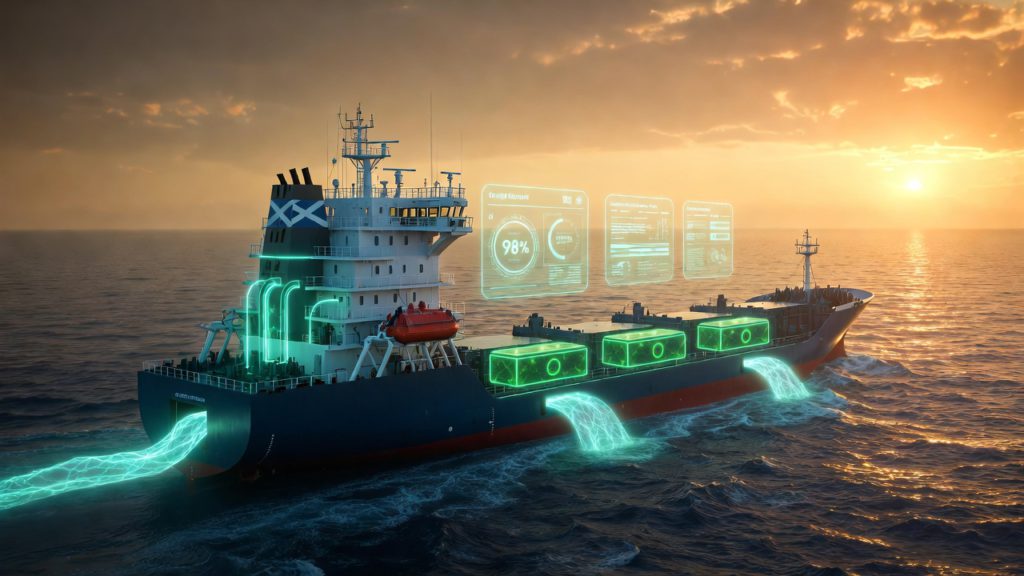
In an industry racing against tightening emissions regulations and ambitious decarbonization targets, a major technological milestone has just emerged that could reshape operations for decades: onboard carbon capture and storage (OCCS) systems are proving their real-world viability at scale. Recent independent verification by DNV has confirmed capture rates reaching up to 98% on a commercial tanker during normal operations, marking a pivotal “hot off the press” advancement in maritime technology.
This isn’t lab hype—it’s happening at sea. Carbon Ridge’s centrifugal OCCS system, tested aboard Scorpio Tankers’ STI Spiga (an LR2 product tanker), delivered peak performance with over half the data points showing 86–98% capture efficiency. The compact design slashes space requirements by up to 75% compared to traditional setups, making retrofits and newbuilds far more practical across diverse vessel types.
Complementing this, the IMO is advancing pathways like carbon mineralization (supported in principle at recent MEPC sessions), turning captured CO2 into stable construction materials. DNV’s new Recommended Practice (RP) provides a standardized framework for measuring, verifying, and certifying OCCS performance—removing key barriers to adoption and regulatory recognition.
Why This Matters for Shipping Professionals
For ship officers navigating daily operations, senior and middle management in shipping companies, and new entrants eyeing a future-proof career in the Merchant Navy: this development signals a shift from fuel-switching alone to a powerful “bridge” technology. Existing fossil-fuel-dependent fleets (still ~90% of the global fleet) gain a viable path to substantial emissions cuts without full replacement.
Operational Impacts:
- Compliance & Economics: Easier alignment with IMO, EU ETS, and CII requirements. Potential revenue from carbon credits or utilization.
- Fleet Strategy: Extends the life and competitiveness of current assets while infrastructure for CO2 offloading (ports, LCO2 carriers) scales up.
- Safety & Reliability: Verified systems reduce risks, with DNV’s framework ensuring robust performance data.
How This Latest Development Affects Maritime Training
OCCS and related decarbonization tech demand new competencies that forward-thinking training providers like those in Glasgow are perfectly positioned to address. Traditional STCW training must evolve to include:
- Technical Skills: System monitoring, maintenance, troubleshooting of capture/liquefaction units, and integration with engine rooms.
- Digital & Data Proficiency: Handling performance verification data, AI-optimized operations, and regulatory reporting under frameworks like DNV’s RP.
- Higher-Order Competencies: Risk assessment for new tech, emergency response in hybrid systems, and cross-disciplinary knowledge (engineering + environmental compliance).
- Simulator-Driven Practice: Facilities with advanced engine room and bridge simulators (such as Europe’s largest hubs in Glasgow) enable realistic scenario training for OCCS operations, fault diagnosis, and shore-side remote oversight—without risking live vessels.
New entrants benefit from curricula blending core seafaring with green tech, boosting employability. Officers and shore staff need upskilling programs—short courses on decarbonization, digital tools, and OCCS-specific protocols—to stay relevant. Institutions are already responding with AI-powered modules and modernized cadet programs, ensuring the workforce isn’t left behind in this fourth industrial revolution at sea.
This tech surge creates opportunities: more shore-based roles in monitoring/optimization, specialized OCCS technicians, and enhanced career progression for those who adapt early.
The Road Ahead
With pilots scaling to commercial deployments and regulatory support accelerating, OCCS could deliver 9%+ fleet-wide CO2 reductions via key port infrastructure alone. For Glasgow Maritime readers—whether on the bridge, in the engine room, or managing fleets—this is your cue to engage with cutting-edge training now.
The future of merchant shipping is lower-emission, tech-enabled, and opportunity-rich. Stay ahead by investing in skills that match the pace of innovation.