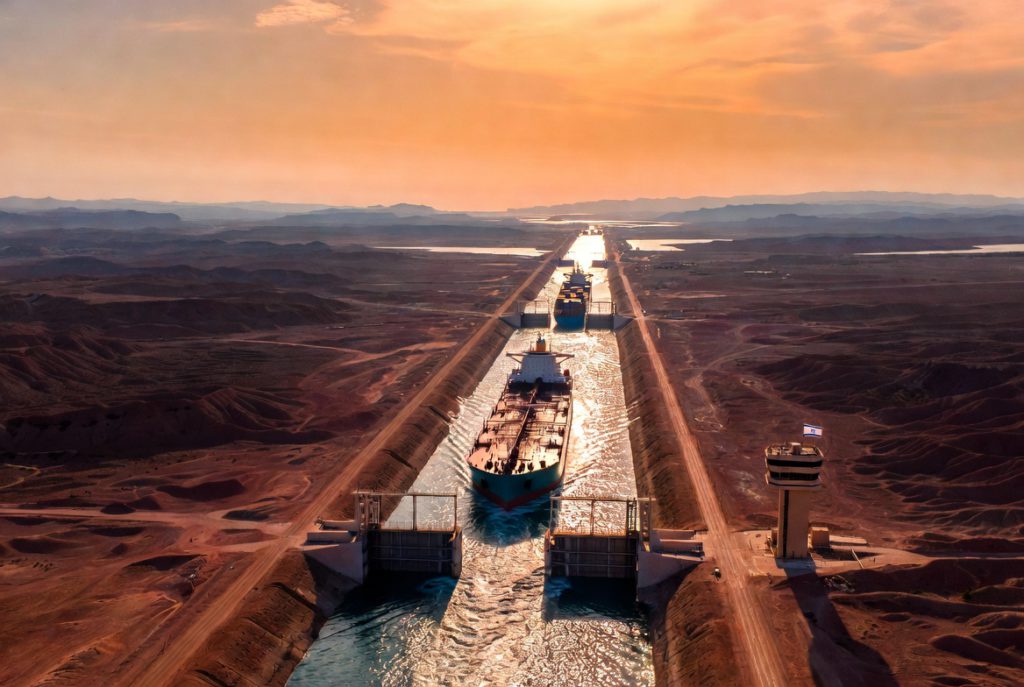
Ben Gurion Canal 2026: Israel’s $55 Billion Suez Rival Back in the Spotlight as Red Sea Risks Persist
Fresh analyses and high-profile discussions in March 2026 have thrust Israel’s ambitious Ben Gurion Canal project back into the global shipping conversation.
With Red Sea disruptions from Houthi activity still forcing many vessels to reroute around Africa, shipping executives, charterers and fleet planners are once again asking: could this proposed mega-waterway finally become the game-changing alternative to the Suez Canal that the industry has speculated about for decades?
The numbers are staggering: a roughly 293 km artificial waterway connecting the Gulf of Aqaba at Eilat (Red Sea) to the Mediterranean coast near Ashkelon. Estimated price tag? Over $55 billion. The project would be longer than Suez but potentially deeper, wider and capable of two-way traffic for the largest modern vessels – a true rival that could reshape transit times, costs and strategic chokepoints for global trade.
For every ship’s officer, cadet and shore-side manager reading this on the Glasgow Maritime blog, the implications are impossible to ignore.
Why the Sudden 2026 Surge in Interest?
Persistent security threats in the Red Sea have already cost the industry billions in extra fuel, insurance and delays. Suez itself remains vulnerable to geopolitical shocks. The Ben Gurion proposal – first floated in the 1960s – offers a politically controlled Israeli corridor that bypasses Egypt entirely and could provide a more secure northern route for certain Asia-Europe trades.
Recent 2026 reports and video breakdowns have highlighted potential integration with new port developments at Eilat and Ashkelon, advanced lock systems and even links to Israel’s expanding rail network. While no shovels have broken ground yet, the strategic conversation has moved from “if” to “when and how” in boardrooms and think-tanks across the industry.
What This Means for Shipping Operations Right Now
Even as a proposal, the Ben Gurion Canal is already influencing long-term routing decisions. Tanker and container operators are modelling scenarios where part of the Asia-Europe flow diverts through an Israeli corridor, potentially shaving days off certain legs while avoiding high-risk zones.
Shore-side management teams are updating risk matrices, reviewing charterparty clauses for alternative routes and stress-testing fleet plans against a future with two competing major canals. Second-hand vessel values, newbuild specifications and even insurance premiums could shift if credible progress on the project materialises.
Implications for Ships’ Officers & New Entrants to the Merchant Navy
Senior officers on deep-sea trades: expect potential new pilotage requirements, canal transit procedures and updated security protocols if the waterway opens. Command on vessels transiting a brand-new artificial canal brings fresh operational challenges – and fresh opportunities for those who prepare early.
New cadets and junior officers: this is exactly the kind of transformative project that creates career acceleration. Officers who can demonstrate knowledge of emerging Middle East routing options, advanced simulation experience on canal passages and strong geopolitical awareness will stand out when companies start bidding for crews on these new trade lanes.
The seafarers who position themselves now – through targeted training and route familiarisation – will be the ones commanding the first vessels through a Ben Gurion transit.
How This Latest Development Will Transform Maritime Training
At Glasgow Maritime and leading academies worldwide, the renewed focus on the Ben Gurion Canal is already prompting syllabus reviews – even before a single metre of channel is dug.
We are accelerating development of:
- Dedicated canal transit simulation modules – realistic scenarios for lock operations, narrow-channel manoeuvring and two-way traffic in a high-security corridor.
- Geopolitical route-planning courses – teaching officers how to assess and compare Suez vs Ben Gurion vs Cape routing in real time, including cost, time and risk factors.
- Updated Middle East navigation and security training – incorporating potential new chokepoints, Eilat/Ashkelon port familiarisation and emergency procedures for alternative corridors.
- Fast-track pilotage familiarisation – short, high-impact programmes for chief officers and masters who may be among the first to take large vessels through the new waterway.
- Expanded cadet pathways focused on emerging trade routes – ensuring the next generation graduates ready for a world with multiple strategic canals.
Training providers that stay ahead of these potential shifts will produce officers who are not just reactive but strategically valuable to shipowners. Those that wait risk leaving their graduates navigating yesterday’s routes while competitors master tomorrow’s.
The steel may not yet be cut, but the planning is very real. The officers and managers who treat this as a live strategic issue today will command the fleets of 2030.
The Red Sea remains volatile. Suez has its limits. Whether the Ben Gurion Canal moves from proposal to reality in the coming years, one thing is certain: the smartest maritime professionals are already preparing for the next chapter in global shipping routes.
Stay ahead. Stay informed. Glasgow Maritime – training the officers who will navigate whatever the future throws at the industry.